Looking to beat the heat or boost air circulation? Our selection of fans and blowers has you covered, whether you need something for your home, garage, or outdoor space. These reliable devices offer a quick and easy way to stay comfortable while improving air flow in any room.
Fans & Blowers
Stay cool and comfortable with our range of powerful fans and blowers designed for every space
Product List
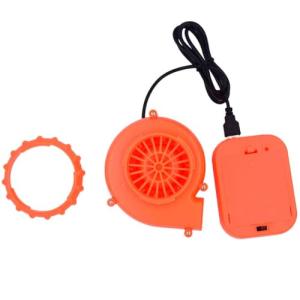
What's the Difference Between a Fan and a Blower?
People use these terms interchangeably, but there's a real engineering distinction. Fans move large volumes of air at relatively low pressure — think of an axial fan mounted in a wall or ceiling, pushing air in one direction across a space. Blowers, on the other hand, generate higher pressure and are designed to push air through ducting, filters, or restricted pathways. They're the workhorses of HVAC systems, industrial processes, and material handling operations.
The key metric that separates them is the specific ratio — the ratio of discharge pressure to suction pressure. Fans typically operate below 1.11, while blowers operate above it. In practical terms: if you need to move a lot of air through nothing more than open space, you want a fan. If you need to push or pull air through something — ductwork, a filter bank, a paint booth — you likely need a blower.
That said, for most buyers, the real question isn't the engineering classification. It's: what does my application need? We'll walk through that below.
Types of Fans & Blowers
Axial Fans
Axial fans pull air along their rotational axis — straight through the blade assembly. They're the most common type of fan and are used everywhere from residential bathrooms to large industrial cooling towers. The blades are angled (like a propeller) to push air forward as they spin.
Common axial fan formats include:
- Panel fans — mounted directly into walls, panels, or enclosures
- Tube axial fans — installed inline within cylindrical ductwork
- Vane axial fans — similar to tube axial but with guide vanes that improve efficiency and reduce turbulence
- Propeller fans — high-volume, low-pressure fans for open-air circulation and cooling
Axial fans shine when you need high airflow with minimal restriction. They're efficient, relatively quiet, and available in a huge range of sizes and voltages.
Centrifugal Fans & Blowers
Centrifugal fans (also called radial fans or squirrel cage blowers) intake air at the center of the fan wheel and throw it outward using centrifugal force, discharging it at 90 degrees from the intake. This design makes them exceptionally good at building pressure.
Sub-types are defined by blade geometry:
- Forward-curved blades — quieter, compact, good for HVAC and light commercial use
- Backward-curved or backward-inclined blades — highly efficient, suitable for clean-air applications, won't overload the motor
- Radial blades — simple, durable, ideal for dirty or abrasive air streams
- Airfoil blades — peak efficiency, typically used in large HVAC applications
Centrifugal blowers are the go-to choice for dust collection, spray booths, fume exhaust, pneumatic conveying, and any application where system resistance is significant.
Mixed-Flow Fans
Mixed-flow fans combine axial and centrifugal action. Air enters axially and is discharged at an angle between axial and radial — giving you higher pressure than a standard axial fan while maintaining much of the airflow advantage. These are popular in inline duct applications where space is tight but performance demands are high.
Inline Duct Fans
Inline duct fans are installed directly within a duct run. They can be axial or mixed-flow, and they're the standard solution for boosting airflow in HVAC systems, grow room ventilation, restaurant exhaust systems, and commercial restroom exhaust. Most are direct-drive with permanently lubricated motors for minimal maintenance.
High-Temperature and Spark-Resistant Fans
Standard fans aren't built for extreme conditions. High-temperature fans use special motor windings, bearing grease, and housing materials to handle airstreams above 200°F — often used in dryers, ovens, and industrial processes. Spark-resistant (or explosion-proof) fans are required whenever the air stream or environment contains flammable gases, vapors, or dusts. These are rated by AMCA 99 construction types (Type A, B, C, or D) and are a safety requirement in many facilities.
Key Specifications to Understand Before You Buy
CFM (Cubic Feet per Minute)
CFM is the most fundamental fan specification — it tells you how much air the unit moves. But here's what a lot of buyers miss: the CFM rating on a fan spec sheet is usually measured at free air (zero static pressure). The moment you add ductwork, filters, or any restriction, that number drops. Always look at the fan's performance curve, not just its peak CFM.
Static Pressure (SP)
Measured in inches of water gauge (in. wg), static pressure tells you how hard the fan can push against resistance. The more ductwork, bends, filters, and restrictions in your system, the more static pressure you need. Industrial blowers are often rated in ounces per square inch (oz/in²) or pounds per square inch (PSI) for higher-pressure applications.
RPM and Motor HP
Higher RPM moves more air but generates more noise and wear. Motor horsepower determines how hard the fan can work — and whether it'll survive running continuously under load. Always select a motor with enough headroom; running a fan motor at or near its nameplate rating continuously is a recipe for premature failure.
Voltage and Phase
Residential and light commercial fans are typically 115V or 208-230V, single-phase. Industrial blowers often run on 208-230/460V, three-phase power. Confirm your available power supply before ordering — mismatched voltage will damage motors.
Sound Level (Sones or dB)
In occupied spaces, noise matters. Sones are used for residential ratings (lower = quieter), while decibels (dB) are the standard in commercial and industrial contexts. If the fan is near workspaces, offices, or living areas, check the sound rating carefully.
Industrial Applications
Manufacturing & Process Ventilation
Industrial facilities depend on reliable ventilation to protect workers and meet OSHA requirements. Centrifugal blowers handle combustion air supply, kiln exhaust, dust collection system airflow, and general process ventilation. In these environments, you need units built for continuous-duty operation with robust bearings and motors that hold up under sustained loads.
Dust Collection Systems
Dust collection is one of the most demanding fan applications. The blower must maintain consistent airflow against the static pressure of filters that continuously load up with particulate. Radial-blade centrifugal fans are preferred here because their simple blade geometry resists buildup and wear from abrasive particles.
Fume and Chemical Exhaust
Labs, plating facilities, and chemical processing plants need fans specifically designed for corrosive airstreams. Fiberglass-reinforced plastic (FRP) fans, PVC-coated fans, and stainless steel units are common in these applications. Never use a standard steel fan in a corrosive environment — the housing will degrade rapidly and create a safety hazard.
HVAC and Building Ventilation
Large commercial buildings rely on centrifugal and axial fans to distribute conditioned air, exhaust stale air, and maintain positive or negative pressure relationships between spaces. Variable frequency drives (VFDs) are increasingly common, allowing fans to operate at variable speed to match actual demand rather than running full-out constantly.
Commercial Applications
Restaurant Kitchen Exhaust
Commercial kitchen exhaust is regulated by local fire codes, and the fans handling grease-laden air must be specifically rated for this duty. Upblast exhaust fans with grease-tight housings, curb mounting, and listed UL 762 ratings are required for most commercial kitchen installations.
Parking Garage Ventilation
Parking structures need ventilation systems designed to dilute and exhaust carbon monoxide from vehicles. Jet fans (high-velocity axial fans) are increasingly used in modern garage designs because they eliminate the need for ductwork while meeting CO concentration requirements.
Data Center Cooling
Server rooms and data centers have extremely specific airflow requirements. Hot aisle/cold aisle containment strategies depend on precision-airflow fans that deliver predictable CFM at defined static pressures. Energy efficiency is a top priority here, and EC (electronically commutated) fan motors are the standard for their variable-speed capability and high efficiency.
Residential Applications
Whole-House Fans
Whole-house fans are installed in the ceiling and pull hot air up and out through attic vents while drawing cooler outside air in through windows. They're an energy-efficient alternative (or supplement) to air conditioning in moderate climates and can significantly reduce cooling costs.
Bathroom and Laundry Exhaust
Bathroom exhaust fans prevent moisture damage and improve indoor air quality. The Home Ventilating Institute (HVI) recommends sizing based on 1 CFM per square foot for bathrooms up to 100 sq ft, with higher airflow for larger spaces or spa-style bathrooms. Sound is a major purchasing factor here — quality fans run at 1 sone or less.
Attic Ventilation
Powered attic ventilators exhaust hot air from attic spaces, reducing cooling loads on air conditioning systems and extending roof life. Solar-powered models are popular for their operating cost savings.
Choosing the Right Fan or Blower for Your Application
Start with these four questions:
-
How much air do I need to move? Calculate your CFM requirement based on room volume and required air changes per hour (ACH), or based on process requirements.
-
What's my system static pressure? Add up the pressure drop across all ductwork, fittings, and equipment in the airstream. Use this to select a fan that meets your CFM requirement at your actual system resistance.
-
What's in the air? Clean air, dusty air, corrosive vapors, and high-temperature gas all require different fan constructions. Get this wrong and you'll be replacing equipment far too soon.
-
What are my operating conditions? Duty cycle, ambient temperature, available power, and noise constraints all influence the right product selection.
If you're still not sure, our team is here to help. Describe your application and we can recommend the right fan or blower for the job.