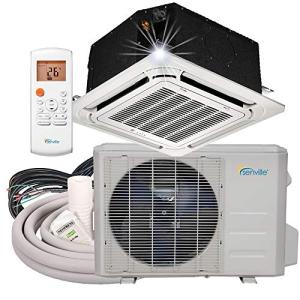
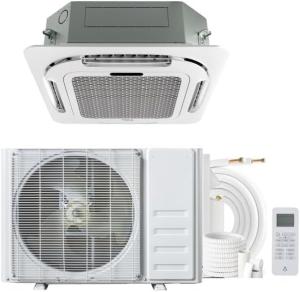
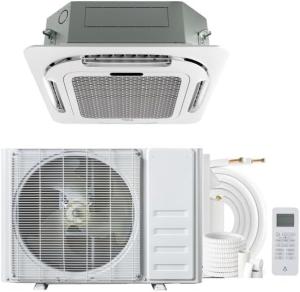
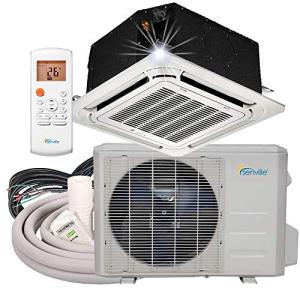
What Is a Ceiling Cassette Mini Split AC?
A ceiling cassette mini split is a type of ductless air conditioning and heating system where the indoor unit is recessed into the ceiling rather than mounted on a wall. Only a slim, square panel is visible from below — typically 2×2 feet or 3×3 feet — flush with the ceiling tiles or drywall. The unit draws air in from the center and distributes conditioned air outward through vents on two, three, or all four sides of the panel.
Like all mini split systems, the indoor cassette connects to an outdoor compressor unit via a small bundle of refrigerant lines, a power cable, and a condensate drain line — no ductwork required. This makes ceiling cassette systems a genuinely ductless solution, distinct from central air systems that rely on an extensive network of ducts running through walls and ceilings.
The result is a system that's powerful, flexible, quiet, and nearly invisible.
How Ceiling Cassette Mini Splits Work
The operating principle is straightforward. The outdoor unit compresses refrigerant and circulates it to the indoor cassette. Inside the cassette, a coil either absorbs heat from your room (cooling mode) or releases heat into it (heating mode). A built-in blower fan circulates the air through the coil and then pushes it back into the room through the directional vanes.
Most modern ceiling cassette mini splits use inverter compressor technology, which means the system doesn't simply switch on and off at full power. Instead, the compressor continuously adjusts its speed to match the exact demand of the room. This keeps temperatures stable, reduces energy consumption significantly, and extends the lifespan of the equipment.
Many units also include:
- Auto-swing louvers that adjust airflow direction automatically
- 360-degree airflow panels that distribute air evenly across the entire space
- Multi-zone compatibility so one outdoor unit can power several indoor cassettes throughout a building
- Built-in Wi-Fi for smart home integration and remote control via smartphone
Why Choose a Ceiling Cassette Over Other Mini Split Types?
Mini splits come in several configurations — wall-mounted, floor-mounted, ceiling-mounted (horizontal ducted), and cassette. Each has its place, but ceiling cassette units offer a distinct set of advantages that make them the preferred choice in specific scenarios.
Superior Air Distribution
The biggest functional advantage of a ceiling cassette is how it moves air. A wall-mounted mini split blows air in one direction from a fixed point on the wall. A ceiling cassette, by contrast, distributes air outward from the center of the room in multiple directions simultaneously. In a square or rectangular room, this creates a much more even temperature — no hot corners, no cold spots directly under the unit.
For spaces larger than 400–500 square feet, or rooms with unusual layouts, this even distribution is a significant practical benefit.
Clean, Unobtrusive Aesthetics
Wall units are visible. They take up wall space, they have a particular visual presence, and in many commercial or upscale residential settings, they're simply not acceptable. Ceiling cassette panels blend into the ceiling plane. In drop-ceiling environments they sit perfectly flush with surrounding tiles. In drywall ceilings they can be finished to match almost exactly.
For restaurants, retail spaces, medical offices, yoga studios, gyms, conference rooms, and high-end residential spaces, this near-invisibility is not a luxury — it's a requirement.
Wall Space Stays Free
In rooms where every inch of wall matters — think reception areas, classrooms, boutique retail — not having a unit mounted at eye level is a real operational benefit. It frees up display space, seating arrangements, and equipment placement in ways that wall units simply can't.
Consistent Comfort in Open Floor Plans
Open-concept spaces are notoriously difficult to condition with wall units because airflow is hard to control and distribute evenly. Ceiling cassettes positioned strategically above a large open area can cover the space comprehensively, making them a go-to choice for open offices, loft apartments, and combined kitchen-dining-living spaces.
Ideal Applications for Ceiling Cassette Mini Splits
Ceiling cassette mini splits aren't the right tool for every job — but in the right applications, they're hard to beat.
Commercial and Retail Spaces — Restaurants, boutiques, salons, and service businesses benefit enormously from the clean look and even airflow. Customers stay comfortable, the décor is uninterrupted, and staff don't have to deal with a wall unit blowing directly on them.
Medical and Dental Offices — Hygiene-conscious environments appreciate the ceiling-mounted installation because it keeps equipment off the walls and floors. Many cassette units also include built-in air filtration that helps reduce airborne particulates.
Hotels and Hospitality — Guest rooms, lobbies, and conference facilities in hotels commonly use ceiling cassette systems. They're quiet, efficient, and easy to control per zone.
Residential Open Floor Plans — Modern homes with large open-concept living areas are excellent candidates. A single properly sized cassette can manage the entire common area of a mid-sized home.
Server Rooms and Equipment Spaces — Because cassettes distribute air uniformly, they're useful in spaces where hot spots around equipment racks are a concern.
Gyms and Fitness Studios — Ceiling mounting keeps the unit out of the way of equipment and foot traffic, while 360-degree airflow handles the heavy ventilation demands of an active space.
Key Features to Look for When Shopping
Not all ceiling cassette mini splits are created equal. Here's what separates a great unit from an average one.
BTU Capacity and Room Size Matching
BTU (British Thermal Unit) rating tells you how much cooling or heating capacity the unit delivers. Getting this right matters enormously. Undersizing a unit leads to a system that runs constantly and still can't keep up. Oversizing causes short-cycling — the unit cools the space too quickly, shuts off, and then the temperature rebounds fast, leading to humidity problems and uneven comfort.
As a rough guide:
- 9,000–12,000 BTU — up to about 500 sq ft
- 18,000 BTU — 700–900 sq ft
- 24,000 BTU — 1,000–1,400 sq ft
- 36,000 BTU — 1,500–2,000 sq ft
Always account for ceiling height, insulation quality, sun exposure, and occupancy when sizing.
SEER2 and HSPF2 Ratings
SEER2 (Seasonal Energy Efficiency Ratio 2) measures cooling efficiency. HSPF2 (Heating Seasonal Performance Factor 2) measures heating efficiency. Higher numbers mean lower operating costs. Look for SEER2 ratings of 18 or above for strong efficiency, and HSPF2 ratings above 9 for solid heating performance.
Many premium ceiling cassette units carry ENERGY STAR® certification, which is a reliable shorthand for above-average efficiency.
Inverter vs. Non-Inverter Compressors
Always choose inverter technology. Fixed-speed (non-inverter) compressors run at full blast until the setpoint temperature is reached, then shut off entirely. Inverter compressors modulate continuously. The result is quieter operation, tighter temperature control, and energy savings of 30–50% over fixed-speed alternatives.
Airflow Direction and Auto-Swing
Look for cassettes with four-way airflow (air distributed on all four sides) and motorized auto-swing louvers. Some advanced units allow you to adjust each vent direction independently, which is extremely useful for rooms with asymmetric furniture layouts or zones you specifically want to avoid blasting with cold air.
Sound Levels
Ceiling cassette units are generally quiet — often operating between 26 and 38 dB in fan-only mode. For spaces like bedrooms, yoga studios, or recording environments, check the manufacturer's decibel specs carefully. Units in the 26–32 dB range are nearly silent. Units above 40 dB will be noticeable in quiet settings.
Built-In Drain Pump
Most cassette units produce condensate that needs to drain away. Some units include a built-in condensate pump that can push water upward against gravity, which dramatically simplifies installation in spaces where gravity drainage isn't possible. If your ceiling installation doesn't have a natural drainage path, a built-in pump is a feature worth prioritizing.
Filter and Air Quality Features
Many cassette units include washable mesh filters as standard. Premium models add multi-stage filtration — activated carbon layers, fine particulate filters, or even plasma ionization and UV-C light systems for enhanced air purification. In medical settings or high-occupancy spaces, these additional filtration features offer real practical value.
Installation Considerations
Ceiling cassette mini splits require more installation planning than wall-mounted units, but the process is well-established and straightforward for qualified HVAC professionals.
Ceiling clearance is the primary structural consideration. The cassette body — typically 10–12 inches deep — must fit above the finished ceiling surface. In drop-ceiling environments this is rarely an issue. In drywall ceilings, there needs to be adequate space between the finished ceiling and the floor or roof structure above.
Refrigerant line routing runs from the indoor cassette through the ceiling void and out through an exterior wall to the outdoor unit. Because the lines are small (typically 1/4" and 3/8" diameter) and flexible, routing is much simpler than running ductwork.
Condensate drainage must be planned before installation. The drain line exits the cassette and runs to an appropriate drain point — either via gravity or with the help of a built-in or auxiliary condensate pump.
For multi-zone setups, a single outdoor unit can support two, three, four, or even more indoor cassettes simultaneously, with each cassette independently controlled. This makes ceiling cassette systems highly scalable for larger buildings.
Maintenance and Long-Term Care
One of the advantages of ductless systems is that maintenance is simpler than traditional ducted HVAC. For ceiling cassette units specifically:
Filter cleaning should happen every four to six weeks in typical use. Most cassette panels include a drop-down access door that makes this easy. Dusty or clogged filters reduce airflow, increase energy consumption, and put unnecessary strain on the system.
Annual professional servicing includes checking refrigerant levels, inspecting electrical connections, cleaning the coil, and testing the condensate drain. This service keeps the system running efficiently and catches small issues before they become expensive repairs.
Outdoor unit maintenance involves keeping the area around the compressor clear of debris, leaves, and vegetation, and having the fins cleaned annually.
With proper maintenance, a quality ceiling cassette mini split should deliver 15–20 years of reliable service.
Frequently Asked Questions
Can a ceiling cassette mini split both heat and cool? Yes. Most ceiling cassette mini splits sold today are heat pump systems — they provide both air conditioning and heating by reversing the refrigerant cycle. Many are effective in heating mode down to outdoor temperatures of -13°F to -22°F, making them viable year-round systems in most climates.
Do ceiling cassette units require ductwork? No. This is the defining feature of mini split systems. Refrigerant lines replace ductwork, which means no energy loss through duct leakage and no need to retrofit duct systems into existing buildings.
How much does installation cost? Installation costs vary by region and project complexity, but a single-zone ceiling cassette installation typically ranges from $1,500 to $4,000 including labor and materials. Multi-zone systems scale accordingly.
Are ceiling cassette mini splits eligible for tax credits? Many high-efficiency models qualify for the federal Residential Clean Energy Credit or the Energy Efficient Home Improvement Credit in the United States. Always verify current eligibility with a tax professional and check current IRS guidance, as limits and qualifying criteria change.
Ceiling cassette mini split air conditioners occupy a unique and well-earned position in the climate control market. They deliver the efficiency and flexibility of ductless mini split technology wrapped in a format that works for spaces where aesthetics, even airflow, and wall space conservation all matter. Whether you're outfitting a commercial space, renovating a high-end home, or upgrading an open-plan office, ceiling cassette systems offer a compelling combination of performance, discretion, and long-term value.